

Construction Company SOPs: What to Document First
By Asli KahramanConstruction and trades businesses run on crews, schedules, materials, and weather. When the work is busy, nobody has time to explain how things are done. When the season ends, the people who knew how things were done are often gone. That's exactly why so many contractors run into the same problems every year: inconsistent job quality, new hires who need weeks of hand-holding, and an owner who still answers every question.
Standard operating procedures fix that, but only if you document the right things first. Trying to write everything at once is how SOP projects stall. This guide walks through what to document first in a construction or trades business, and how real companies in fencing, paving, flooring, and roofing structured theirs.
Why Construction Companies Need SOPs More Than Most
A few things make construction and trades harder to run without documentation:
- Seasonal and high-turnover crews. Every season brings new installers or laborers who need to learn your standards fast.
- Work happens away from the office. The owner can't stand over every job site. The standard has to travel with the crew.
- Quality and safety depend on consistency. Application methods, sequencing, and safety steps need to be followed the same way regardless of who's on the job.
- Office and field have to stay in sync. Estimates, scheduling, material orders, and invoicing all depend on clean handoffs between people who rarely sit in the same room.
What to Document First
You don't need hundreds of SOPs on day one. Start with the processes that repeat the most and cause the most problems when they go wrong.
1. Your customer journey, from lead to final invoice
Map how a job moves through your business: inquiry, site visit, estimate or proposal, approval, scheduling, pre-installation, the job itself, quality control, final walkthrough, invoicing, and warranty or follow-up. Once this is written down, everyone can see where their work fits and where handoffs break. If you only document one thing this month, make it this. We explain why in why your customer journey should be the first thing you document.
2. Field checklists
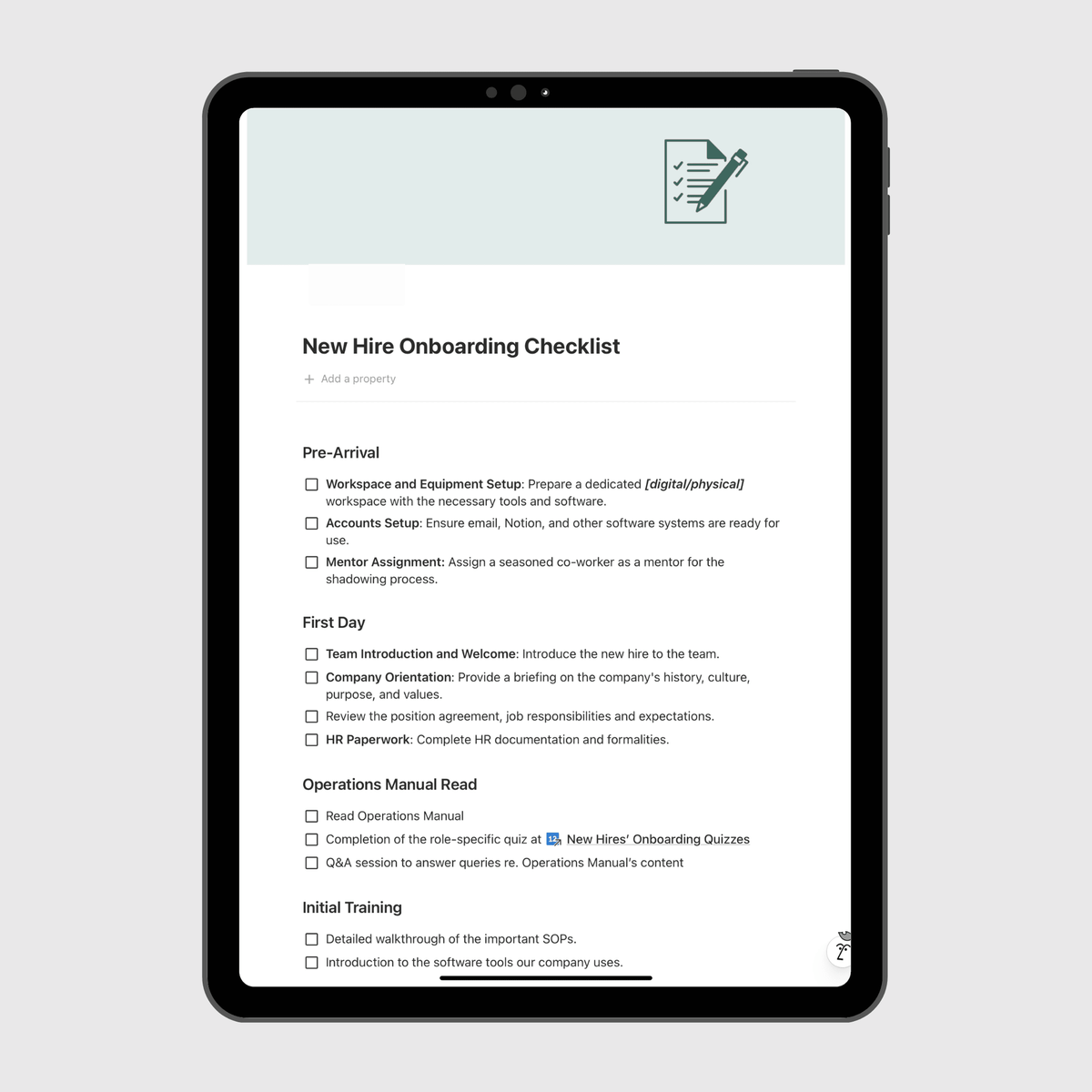
Checklists are the fastest way to standardize work on site. Start with a job start checklist, a job closing checklist, and a quality control checklist for your crews. They're short, easy to follow on a phone, and they catch the mistakes that lead to callbacks.
3. Scheduling, materials, and office workflows
Document how crews get scheduled, how materials are ordered and received, how follow-ups are handled, and how change orders are created. These are the processes that usually live with one office person, and the business feels it immediately when that person is out.
4. Roles, job descriptions, and training roadmaps
Write down every role, who it reports to, and what it's responsible for. Then build a training roadmap for the roles you hire most often, like installers, schedulers, or customer service. This turns "shadow someone for two weeks" into a clear path new hires can follow.
5. Technical and safety standards
The methods that make your work look professional, and the steps that keep your crew safe, need a written standard. It's what you train against and what you hold the team accountable to.
6. Tool tutorials and a glossary
Record short walkthroughs of the software your team uses every day, and keep a glossary of trade terms so new hires from outside the industry can follow conversations from day one.
How to Structure Construction SOPs So Crews Actually Use Them
The structure matters as much as the content. What works best for trades businesses is one operations manual with a separate SOPs hub for each team: all staff, office, sales, field crews, management, and accounting where relevant. Each person goes straight to the part that applies to them.
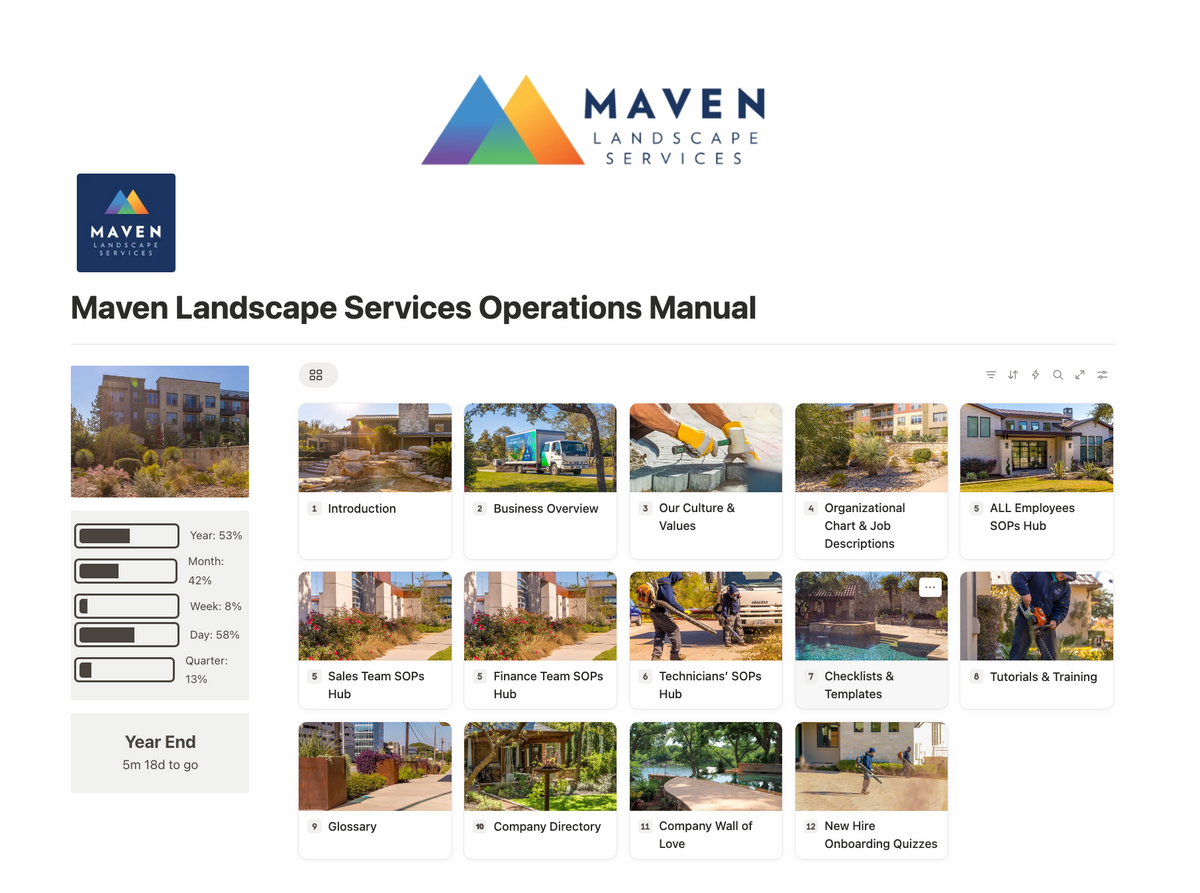
An operations manual for a landscaping business, with a separate SOPs hub for each team.
A few practical tips:
- Make it mobile. Field teams will read SOPs on their phones. Keep steps short and checklists scannable.
- Use video where showing beats telling. A two-minute clip of a technique often replaces a page of text.
- Write in the language your crew speaks. If part of your team is more comfortable in another language, translate the field SOPs.
- Keep management-only material separate. Accountability charts, meeting agendas, and pricing decisions belong in a section only leadership can access.
For trades and home service businesses, we often add before-and-after photos right inside the SOP: this is what a finished job looks like, and this is what the site should look like after clean-up. Your crew opens it in the Notion mobile app on site and sees the standard instead of guessing it.
Real Examples From Construction and Trades Businesses
Landworks Fence: a bilingual field team, documented
Landworks Fence is a residential and commercial fencing company in Connecticut with 15 installers and 6 office team members, built around a seasonal installer workforce. Most of the know-how lived with the owner, Lucas. We built a 12-section operations manual with five dedicated SOPs hubs, including a field team hub with an installer master checklist, job start and job closing checklists, and an installer quality control checklist. Because much of the crew is Spanish-speaking, the field SOPs and guidelines were translated into Spanish. The project took nine knowledge extraction sessions and produced 124 SOPs and tiles. Read the Landworks Fence case study.
Topline Pavement Services: ready for the busy season
Topline Pavement Services provides pavement services across Southern Ontario, with ten trailers on the road. Their SOPs existed but were scattered, and one person was holding the office operations together. They started during their low season so the manual would be ready before new office and tech team hires came on board. The manual includes a tech team hub that documents application methods, safety standards, and task sequencing, and the project produced 126 SOPs in seven sessions. Read the Topline Pavement case study.

As Emily Hirst from Topline put it: "Working with Operations Mavenue was an outstanding experience."
Aurora Flooring: four divisions, one source of truth
Aurora Flooring is a flooring and roofing company in Anchorage, Alaska, with more than 60 people across four divisions. Each sales division got its own SOPs hub with the full client journey, from initial contact and job site visit through proposal, approval, pre-installation, quality control, and warranty. Alongside those, there are hubs for the field team, warehouse, admin, HR, and management. The result: 320 SOPs across 18 sections. Read the Aurora Flooring case study.
When to Do It
The best time to document a construction business is the slow season. You have the headspace to look at what went wrong last year, and the manual is ready before the next wave of hires. We cover this in how to use your low season to document your processes.
Frequently Asked Questions
What SOPs does a construction company need first? Start with the customer journey from lead to final invoice, field checklists for job start, job closing, and quality control, and the scheduling and material ordering workflows. These cover the work that repeats most and causes the most problems.
How many SOPs does a construction company need? It depends on the size and number of teams. The trades businesses in our case studies ended up with between 124 and 320 SOPs, but they started with the core processes and built out from there.
How do you get field crews to follow SOPs? Keep field SOPs short and mobile-friendly, use checklists and short videos, write them in the language your crew speaks, and build them into onboarding so every new hire learns from the manual from day one.
Can existing documents be used? Yes. Existing SOPs, checklists, and forms can be reviewed, improved, and brought into the manual instead of starting over.
Ready to document your construction business?
See how our Custom Operations Manual service works: we interview you and your team, write your SOPs, and build your complete operations manual in Notion. Or fill out our Custom Inquiry Form to tell us about your business.
See more results on our case studies page.